

Current Exhibition: September 18, 2026 — October 31, 2026
The works of Leah Dixon and Carlos Rosales-Silva share a materially obsessive impulse to critique the colonial appetites of the Western world. In Castle in the Desert, their critical lenses combine through the “Imperial Boomerang,” a theory originated by Aimé Césaire in which repressive techniques used to control colonial territories are eventually deployed domestically against a nation’s own citizens.
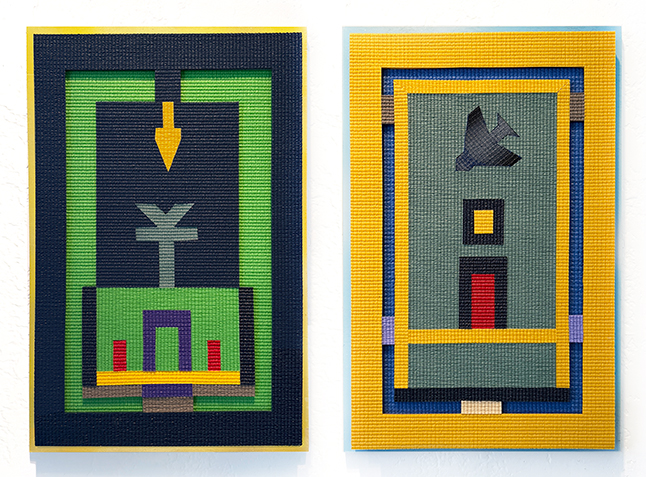
Dixon’s American War Rugs, hand-cut from yoga mats, draw from Afghan war rugs depicting histories of conflict through images of weapons, tanks, and aircraft. Dixon contrasts these images with the American wellness industry and its promises of self-improvement and transcendence. At Presa House, the works are displayed amongst rubble of drywall, creating a colorful landscape of a home ripped to shreds.
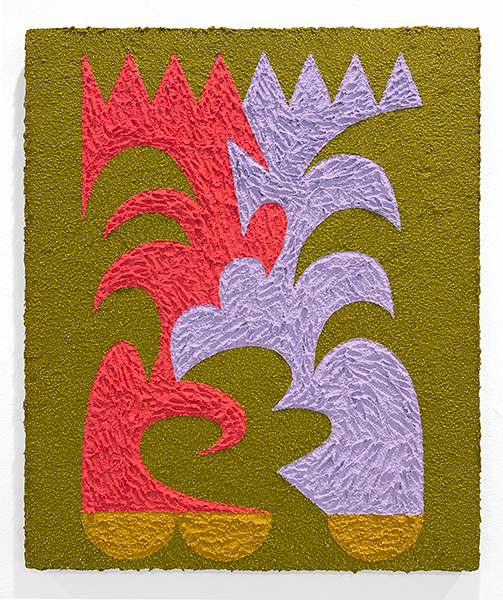
Rosales-Silva’s paintings and murals use saturated color, texture, and interlocking abstract forms to resist categorization and create spaces of disorientation. His abstraction seeks to shatter the brutal logic of binaries he encountered growing up along the border of the United States, Mexico, and Indigenous land.
Castle in the Desert is both structure and metaphor: an interloping fortress that must constantly be defended. These castles exist abroad in lands invaded and occupied, along borders where being and non-being are enforced, and in our homes where tools of state and corporate media and surveillance increasingly divide our population.
Leah Dixon (b.1982) is a New York City–based artist whose sculptural practice investigates the relationship between bodies and architecture in shared spaces. Using a self-made language of modular geometry and personal color science, she builds highly physical structures that reference intangible structures of knowledge, power, and belief.
In her American War Rugs series, Dixon creates hand-cut compositions from yoga mats, a body of work she began at the height of U.S. military involvement in Afghanistan. The series developed after Dixon learned about Afghan war rugs, including those made by Afghan women refugees living in Kashmir in the 1980s who wove geometric narratives of war into traditional rugs. Later weavers incorporated American jets, tanks, and depictions of 9/11. Dixon was struck by how sharply these images of conflict contrasted with the expanding commercial wellness industry, which encouraged Americans at home not to look outward but to turn toward the “self” with promises of improvement and transcendence.
As both a critique of the commercialization of self-care and an homage to Afghan war rugs, Dixon reinvents the yoga mat through American imagery and a scathing sense of irony. At Presa House, the works are installed within a landscape of cut, bent, and painted drywall, creating a colorful deconstruction of the domestic.
Dixon has exhibited internationally and holds a BFA from The Ohio State University and an MFA from the School of Visual Arts. She is also the founder and creative director of BEVERLY’S in Lower Manhattan.
To learn more about Leah visit www.leahdixonart.com
Carlos Rosales-Silva (b. 1982) was born along the U.S.–Mexico border in El Paso, Texas. His studio practice considers the vernacular culture of the American Southwest, the Western canon of art history, and the political and cultural connections and disparities between them. Informed by the architecture, landscapes, and vernacular cultures of the borderlands where he grew up, his work considers histories of colonization and the influence of Indigenous design and material culture on Western art, design, and architecture.
Rosales-Silva works with saturated color, varied textures, and interlocking abstract forms that approach architecture, landscape, or still life while resisting categorization. He describes this disorienting abstraction as a means of shattering the binaries created by “border logic.” Central to his practice is the study of color as an interdependent system: the way we perceive one color is determined by the colors surrounding it. For Rosales-Silva, this is an “anti-border logic”—we cannot see anything without the influence of everything around it.
His research traces relationships between Indigenous design, traditional Mexican craft and material culture, modernist art and architecture, and the quotidian forms of Latinx culture. These hybrid forms occupy spaces between categorization and reveal histories of cultural exchange often overlooked within mainstream art history.
Rosales-Silva has exhibited throughout the United States and Mexico and has participated in residencies at Artpace, Pioneer Works, Abrons Arts Center, and Residency Unlimited. He received his MFA from the School of Visual Arts in 2020.
To learn more about Carlos visit www.carlosrosalessilva.com